Many students notice exchange students but don’t really think about what it took to get to where they are. The long flights to and from home, saying goodbye to friends and family, and learning a new language are all very difficult things, no matter who you are. It takes lots of courage and determination to come to a completely new high school across the globe, so let’s talk about what the process of getting here is like.
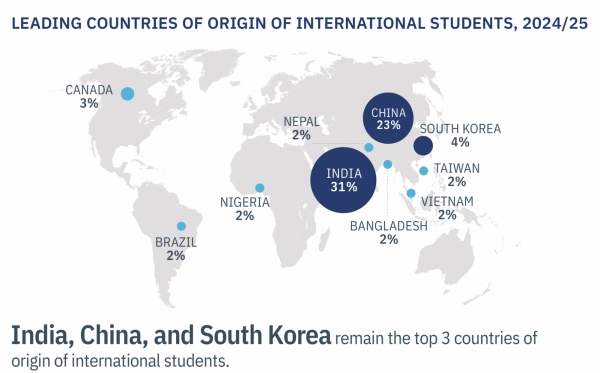
Exchange students come from all over the world, but the one country that the U.S receives the most students from is India, at about 363,000 in the 24-25 school year, according to Open Doors 2025 Report on International Educational Exchange. Having to leave their own country and come out of their comfort zone builds independence, confidence, and adaptability.
Some people might wonder how much it costs to be an exchange student, so let’s talk about that. According to The IIE and The US Department of State, program fees are often the highest cost at $8k-15k+ for full-year programs and $2k-5k for shorter summer programs. Travel costs can be quite expensive as well, depending on the distance, at $800-$2000. Federal fees include a $185 visa application and a Student and Exchange Visitor Information System fee, which is $220.
Health insurance is also a concern because it is a requirement, but costs can vary depending on the plan. Living expenses can be around $250-$400 monthly, which includes simple things like going out with friends or weekend trips. Besides these costs, it is possible to encounter additional costs and fees depending on extracurricular activities, vacations, and specific allergies for some reason.
Why would someone want to leave their own country just to go to school in another country with a different family? Well, according to the U.S. Department of State, it is for many reasons.
First, language fluency and understanding. Someone living in a foreign country is obviously not going to speak our language too well, just like we wouldn’t be able to speak theirs. A key reason students come to America is to learn and be fluent in English through complete immersion.
Another reason to leave home is to experience new cultures firsthand to break stereotypes and form international friendships.
The third reason is gaining an edge on future college or career moves. Studies from the U.S. Department of State show that exchange students often have better odds at securing jobs and being admitted to college because of their ability to speak multiple languages and independence.
Let’s not forget about the wonderful host families who take these kids in as family, not just guests. In the US, it is required that the host family be full-time legal residents of the U.S, pass background checks, and be able to provide a safe living environment. A few minor requirements include three daily meals, ensuring transportation, and that English should be the main language spoken in the house. A few unspoken rules are helping the student adjust and adapt to American life and school, financial stability, maintaining regular contact with the program coordinator to address challenges as they arise, open-mindedness, and, finally, equal treatment of kids in the household.
In conclusion many students come to the U.S from 200+ countries and that takes lots of courage. Over 1.1 Million exchange students were enrolled in US schools in the 24/25 school year; that’s a lot of people interested in living an almost completely different life with a new family to better their education or understanding of English.