
Every third Monday of January teens all across America thank Martin Lurther King Jr. for giving them a day off school, but MLK Day is more than just a day off work and school. It’s a day of true remembrance for one of the greatest American activists to ever walk this Earth.
Martin Lurther King Jr., otherwise known as MLK, was born in Atlanta Georgia on January 15, 1929. King came from a well-off middle class family and both of his parents were college educated. He was born during a time of racism and segregation across a majority of America. Growing up in the south, segregation played a prominent role in his life.
King attended a segregated school, and later attended Morehouse College at the age of 15. However, the summer before King went to college he worked at a tobacco farm in Connecticut. When he was in Connecticut he learned segregation wasn’t as common as it was in the south. He saw people of all races attending the same church and eating at the same restaurants. This flipped a switch in King and it sparked his drive to end segregation in America.
During his time at college he studied medicine and law, until his senior year when he decided to follow his father’s and grandfather’s path and go into the ministry. King graduated college in 1948 to then continue his education at Crozer Theological Seminary for three more years. During his time at Crozer he was elected student body president. He governed over an almost completely white body of students. After Crozer he decided to go to Boston and further study ‘man’s relationship with God’. While in Boston, King met Coretta Scott; they married in 1953 and had four kids.
They moved to Montgomery, Alabama, and King was a pastor at Dexter Avenue Baptist Church. King was a part of a small civil rights group; that group decided they needed to do something after a bus incident involving Rosa Parks. The group decided to create the Montgomery Bus Boycott and put King in charge. The Bus Boycott consisted of people boycotting the segregated buses until the buses could no longer run, or until they desegregated. They had people that would drive some cars around offering to pick up people who were participating in the boycott, otherwise people were advised to walk. King led the boycott for a little over a year until the Montgomery buses were desegregated on December 21, 1956.
After the bus boycott, King now had his footing in the civil rights field. He decided to keep protesting and holding speeches to help convey his message in a peaceful way.
He started the Southern Christian Leadership Conference or the SCLC. The SCLC allowed for better communication between activists in the south.
In 1959 King was able to talk to the Prime Minister of India where they talked about Gandhian policies and King realised that peacefully protesting was the only way toward progress in the civil rights movement.
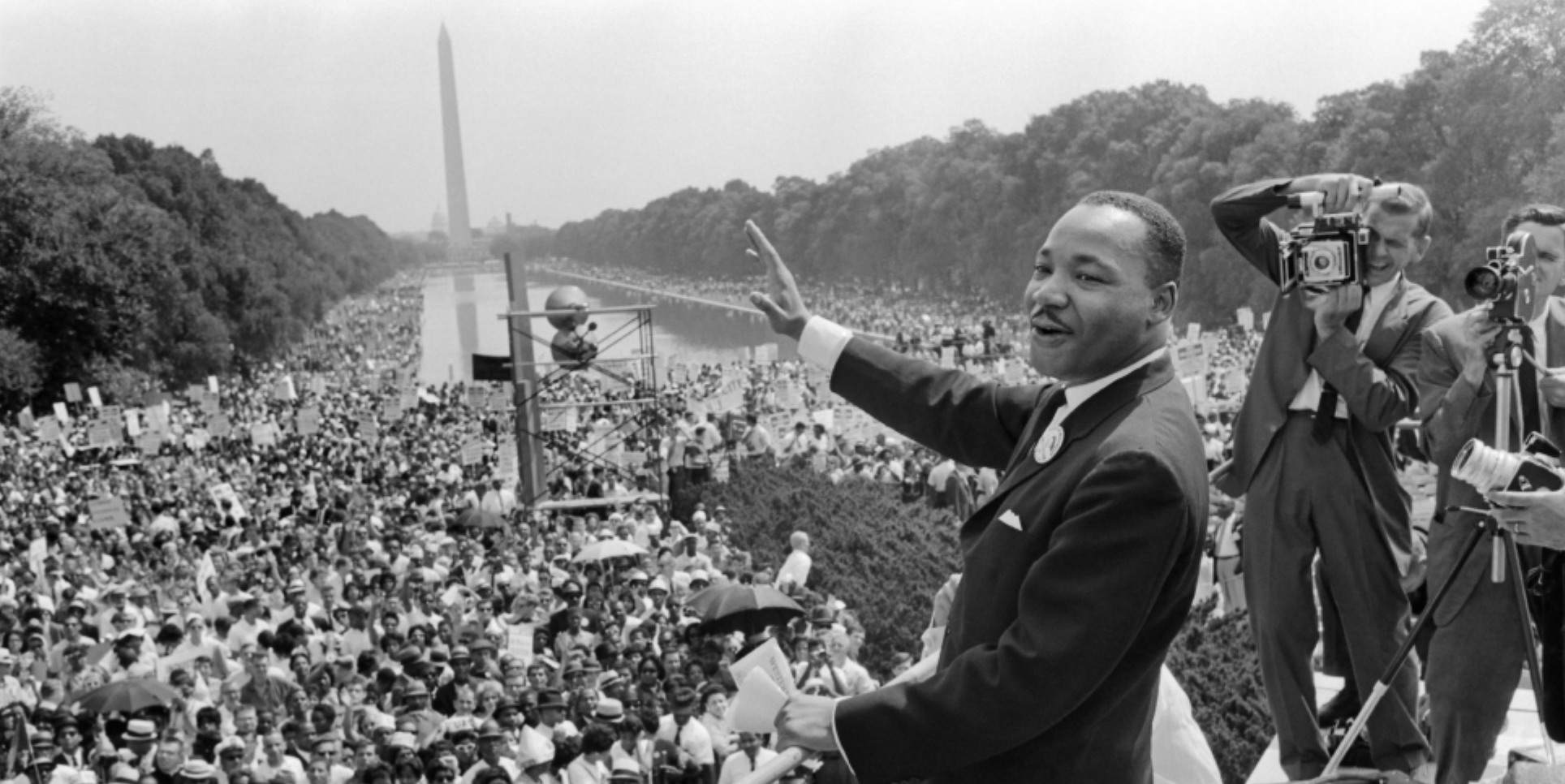
One of King’s most famous protests was the March on Washington. On August 28, 1963, over 250,000 Americans gathered at the Washington monument to walk a mile to the Lincoln Memorial to honor Lincoln for signing the Emancipation Proclamation a century earlier. At the Memorial a set of speakers gave speeches including King’s “I Have a Dream” speech.
While most of King’s protests started off in a peaceful way, they would often turn violent due to police brutality and hate from racist civilians in the south. An example is the infamous “Bloody Sunday.” On March 7, 1965, King organized a march from Selma, Alabama, to the state capitol in Montgomery, to protest voting rights for African Americans. It was a peaceful march led by John Lewis and Hosea Williams, until the protesters were stopped by a barricade of state troopers on Pettus Bridge right outside of Selma. The state troopers used night sticks and tear gas against the protesters. The troopers put hundreds of protesters in jail. The violence shocked the country. Two days later, King held another protest on the same bridge, however the protesters kneeled and prayed before the troopers. This led to King losing many radical supporters.
On April 3, 1968, King was in Memphis Tennessee in support of a sanitation worker strike, whe gave a speech, saying “I’ve seen the promised land. I may not get there with you. But I want you to know tonight that we, as a people, will get to the promised land.”
The next day he was shot and killed on the balcony of the Lorraine motel. The shooter, James Earl Ray, was sentenced to 99 years in prison.
King will forever be known as a leader who guided America towards desegregation and the end of racism. King is honored every third Monday of January to celebrate his birthday and honor all he did for our great country.