Creativity is a vital part of our lives, not only as it provides itself as a lens through which we can view the world, but it also is a way that people can view the world in similar or dissimilar ways.
When learning how to be creative, or finding a preferred outlet for creativity, one must go through a trial and error adjacent process in which they have to learn to fail. They may attempt something that doesn’t work, or make a fool of themselves trying to create something out there or a bit whacky, but that is all a part of the creative process.
Anne Otte, the teacher of a helpful handful of art classes here at the high school sees this value of trial and error within her own courses.
“It’s really important for kids to learn how to be creative and to think in different ways,” said Otte. “[But it’s also] important to understand that you’re not gonna be an expert at every skill when you first start it, and being able to work through those challenges is really important. It helps you be a better student overall.”
With this aspect of trial and error, being a creative individual takes effort. You are going to fail, and there are going to be some sparks, scratches, or stains, but you also have to realize that you’ve gotta get back up and try again. Failure and mistakes aren’t something to be ashamed of all the time. What elementaries have tried to hammer into kids’ heads for years is true: you learn from your mistakes.
So, while mistakes can be discouraging for students, kids, or anybody attempting to find creativity in their lives, it’s that interest and that passion that gets them back up and keeps them going. And on top of that, seeing someone else’s work in the same field shouldn’t knock you down, but should instead inspire you to stay up, and keep going.
“[During] textiles class when they all want to be interested in art, it’s more fun, and they feed off each other with their designs,” said Aimee Marasco, SEP High School’s primary FCS teacher. “In textiles, you all have the same basic project, but you can adjust it with your creativity. Like some kids were embroidering on their tote bags, some kids could have tie-dyed it if they wanted to. There are those options.”
Everyone has their own unique perspective through which they see the world, and that is an important aspect of creativity. The world wouldn’t be what it is without what we as a society have created it to be.
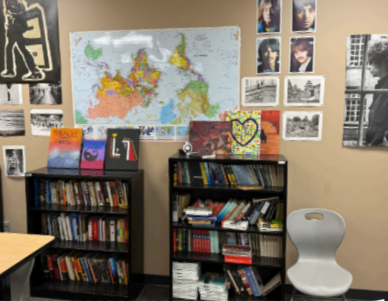
SEP High School English teacher Chris Snethen pointed out the idea that everything is just masses of colors and shapes. Books on a shelf with a map and pictures of faces above it are just blobs of colors presented in different ways with various hues, but it’s human creativity that actually has put a name to those kaleidoscopic bodies that gives our lives a reason.
We exist for creativity.
“We’ve got a very limited amount of time on the Earth, and I don’t want to waste it on nonsense,” said Snethen.
This is the human idea; this is how the human species operates. Creativity is at the base of all that we do. As time has gone on, we have created meaning for things, and turned lip movements paired with vocal chord strums into words. Those words found meaning, some are empowering, and some are hurtful. That was paired with “music, the great communicator,” where, as per Red Hot Chili Peppers, we’d “use two sticks to make it in the nature.” Then sticks were adhered to hairs and powders were mixed with oils to create visual stimuli that appeased eyes as music pleasured ears.
The entire essence of pleasure within human life comes from creativity. We’ve had to make the world bearable, so creative speakers, turned musicians, artists, engineers, inventors, and innovators of any kind have had to be creative. And so I leave you with this:
“As we experience life, we have to come up with some sort of meaning, or else we wither,” said Snethen, “and I think that creativity sort of gets at that forefront of making meaning of the world—out of a meaningless world. And so practicing that, creating something new, is a vital thing to do.